
One of the most common observations among competitive cyclists is this:
Some riders produce excellent numbers in training but struggle to replicate those performances in races. Others seem to do the opposite — their training files may look relatively ordinary, yet when the race begins they consistently perform at a high level.
It can be confusing. If training data shows a rider is strong, why doesn’t that strength always appear in competition?
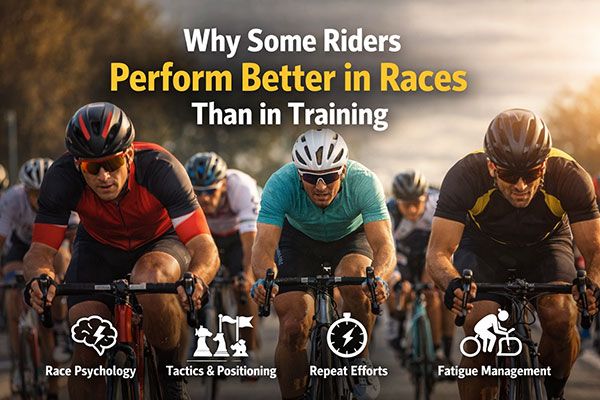
The answer is that racing places demands on cyclists that extend far beyond simple physiological fitness. Power numbers and structured workouts are important, but racing introduces a complex combination of psychology, tactics, fatigue dynamics and repeatability that often determines who performs well when it matters.
Understanding the difference between training fitness and race performance is one of the keys to becoming a stronger racer.
The Psychological Effect of Competition
The most immediate difference between training and racing is the presence of competition.
During training, most efforts are performed in controlled conditions. Riders follow structured intervals, pacing targets and recovery periods. Even when training with others, the environment is usually predictable.
Racing is very different.
The moment the race begins, the psychological environment changes dramatically. Riders are surrounded by competitors, positioning becomes important, and the pace of the group is dictated by the collective actions of dozens of athletes rather than a planned interval session.
This environment introduces several powerful psychological effects.
Adrenaline and Motivation
Competition naturally increases adrenaline levels. This physiological response can temporarily increase alertness, focus and pain tolerance.
Many riders find they can push significantly harder in a race situation than they would during a solo training effort simply because the competitive environment demands it.
The presence of other riders also increases motivation. The desire to hold position, respond to attacks or stay with a fast group often drives riders to dig deeper than they would during a training session where stopping or easing off carries no immediate consequences.
Risk Tolerance
Racing also changes how riders perceive risk and discomfort.
In training, athletes are often careful about pacing and fatigue management. In races, riders may be willing to push well beyond what they would normally consider sustainable because the competitive stakes justify the effort.
This willingness to take risks with pacing can lead to higher peak outputs and more aggressive riding.
For some riders, this environment unlocks performance they rarely reach during training.
Race Craft and Tactical Efficiency
Fitness is only one component of racing performance.
Another major factor is how efficiently a rider uses their energy during a race.
This is often referred to as race craft.
Experienced racers understand that conserving energy early in a race can dramatically influence performance later. They know when to move forward in the peloton, when to sit in and recover, and when to respond to attacks.
These decisions have a huge impact on how much energy a rider expends.
Positioning in the Peloton
One of the simplest but most important aspects of racing is positioning.
Riders near the front of the peloton often experience smoother pacing and avoid the “accordion effect” that occurs further back in the group. This effect can cause repeated accelerations that waste energy unnecessarily.
However, staying near the front requires skill and awareness. Riders who are inexperienced or hesitant may drift backwards in the group, forcing them to work harder to maintain contact.
Over the course of a race, these small differences in energy expenditure can add up significantly.
Choosing the Right Efforts
Another element of race craft is knowing when to respond to attacks.
Inexperienced riders often try to follow every acceleration in the race. While this may seem aggressive, it can quickly lead to excessive fatigue.
Experienced racers tend to be more selective. They recognise which moves are dangerous and which are unlikely to succeed.
By conserving energy and choosing the right moments to commit, they arrive at the decisive phase of the race with more strength available.
This tactical efficiency often explains why some riders outperform others despite having similar or even lower physiological numbers.
The Importance of Repeatability
Another major difference between training and racing lies in the structure of efforts.
Most training sessions involve clearly defined intervals. Riders may perform threshold efforts, VO₂max intervals or endurance rides with steady pacing.
Racing rarely follows this pattern.
Instead, races often involve repeated accelerations of varying intensity.
Examples include:
- Exiting corners in a criterium
- Responding to attacks in a road race
- Closing small gaps in the peloton
- Fighting for position before a climb
These efforts are often short but frequent.
Over the course of a race, riders may perform dozens of small surges above threshold power. While each effort may only last a few seconds, the cumulative fatigue can be significant.
Some riders naturally tolerate this type of repeated effort much better than others.
These riders tend to excel in race situations because they can repeatedly respond to changes in pace without rapidly accumulating fatigue.
The Influence of Fatigue
Fatigue behaves very differently in racing compared to structured training.
During a typical training session, riders know when intervals will begin and end. They also know how many efforts remain.
In races, fatigue develops unpredictably.
A rider may experience multiple accelerations, sudden climbs or tactical surges that were not anticipated. This randomness places additional demands on the body and the mind.
Late in races, the ability to produce meaningful power despite accumulated fatigue becomes particularly important.
Riders who maintain performance deep into races often appear significantly stronger than those whose performance declines sharply after several hours of work.
This is why durability and fatigue resistance have become increasingly important concepts in endurance training.
Experience Matters
Another factor that strongly influences race performance is experience.
Riders who have competed frequently develop a better understanding of race dynamics.
They learn how to read the behaviour of the peloton, anticipate attacks and position themselves efficiently.
This knowledge allows them to make better decisions during races, conserving energy and responding more effectively to key moments.
In contrast, riders who are new to racing may waste energy unnecessarily simply because they are still learning how races unfold.
As experience grows, many riders find that their race performances begin to improve even without major changes in their underlying fitness.
Bridging the Gap Between Training and Racing
The goal of training is not simply to produce impressive numbers in a power file.
The goal is to prepare riders for the demands of racing.
This means training programmes should include sessions that reflect the realities of competition.
Examples might include:
- Repeated short accelerations within longer efforts
- Hard intervals late in long rides
- Sessions designed to simulate race dynamics
- Group rides that replicate the unpredictable pacing of races
These approaches help riders develop the repeatability, fatigue resistance and decision-making skills required to perform well in competition.
Turning Fitness Into Results
Ultimately, race performance is the result of several interacting factors:
- Physiological fitness
- Tactical awareness
- Positioning skills
- Psychological resilience
- Fatigue resistance
Training improves fitness, but translating that fitness into results requires a broader understanding of racing itself.
At Ride Revolution, coaching focuses not only on developing strong physiological performance but also on helping riders apply that fitness effectively in competitive environments.
Because in cycling, the strongest rider on paper is not always the rider who wins.
Often, it is the rider who knows how to use their strength when it matters most. Get in touch to find out how we can help you be your best.